How to Choose Baby Bottles: A Practical Buying Guide
Recommended picks
- Dr
Dr. Brown's Natural Flow Anti-Colic Options+ Narrow Baby Bottle, 8
$24.9910,000+ bought last monthView on Amazon


Pick a Bottle Material
Baby bottles come in three main materials, each with a clear trade-off. Soft silicone bottles, like the Comotomo (B004C053BA, 4.7 stars across 64,300 reviews, $16.99), have a squeezable body that feels closer to skin and is a common choice for moving a baby between breast and bottle. Plastic bottles are the lightest and most drop-proof, which matters once your baby starts holding the bottle, and they make up the bulk of affordable multi-packs such as the Dr. Brown's sets (B01845QH7M, B07G9ZKDCR). Glass bottles are heavier and can break, but some parents prefer them because they resist staining and odors and handle repeated sterilizing without clouding. There is no single best material. For the most nursing-like feel, silicone is the usual pick; for the lightest and cheapest option to stock in volume, plastic wins. Whatever you choose, confirm the brand lists the bottle as BPA-free, which is now standard across the major feeding brands.
Decide Whether You Need Anti-Colic Venting
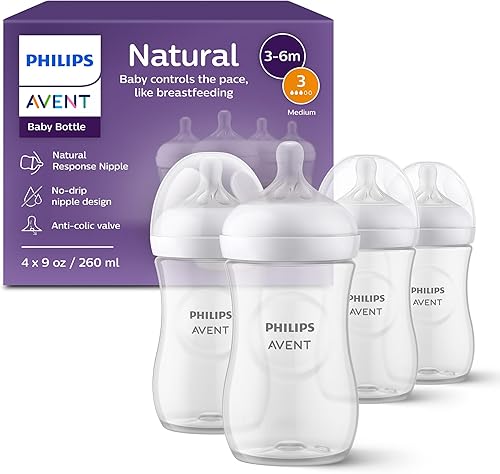
Many newborns swallow air during feeds, which can lead to gas, hiccups and spit-up. Anti-colic bottles are designed to reduce how much air the baby takes in, and they come in two main styles. Internal-vent systems, like Dr. Brown's (B01845QH7M, 4.8 stars across 52,000 reviews), use a tube that channels air away from the milk and are among the most reviewed feeding products anywhere. Vented-base or valve systems, like MAM (B09H7NKY6N) and Philips Avent (B0964CHD65), reduce air with fewer parts to wash. If your baby is gassy, spits up often or pulls off the bottle mid-feed, lead with an anti-colic design. The trade-off is cleanup: internal-vent bottles add an extra part per bottle, while vented-base bottles are simpler but may vent slightly less aggressively. Our anti-colic guide covers how each system works in more detail.
Choose the Right Bottle Size
Bottles generally come in two sizes: a smaller 4 to 5 ounce bottle for newborns and a larger 8 to 9 ounce bottle for older babies who take bigger feeds. Newborns drink very little at first, so a small bottle like the Lansinoh 5 ounce three-pack (B00H0DH2NS, 4.7 stars across 21,800 reviews, $18.69) or a 4 ounce Dr. Brown's (B0F54RF5BZ) is usually plenty for the first couple of months. As your baby grows, an 8 or 9 ounce bottle such as the Tommee Tippee 9 ounce six-pack (B00K5KVC52) or Boon 8 ounce (B07BL83415) saves you from refilling mid-feed. Many parents buy a small set to start and a larger set around three to four months, while others buy large bottles from day one and fill them partway. Both work. If you only want to buy once, larger bottles are more flexible since you can always under-fill them.
Match the Nipple Flow to Your Baby's Stage
Every bottle nipple has a flow rate, usually labeled by stage or by age. Newborn or slow-flow nipples release milk slowly so a young baby does not get overwhelmed, while medium and fast-flow nipples suit older babies who feed more efficiently. Most bottles ship with a slow-flow nipple and sell faster nipples separately as your baby grows. The signs are clear once you know them: a baby straining and sucking hard with little milk usually needs a faster flow, while a baby gulping, dribbling and pulling off may need a slower one. Sticking with one brand makes this easier because nipples are generally cross-compatible within a brand's own bottle line but not across brands. When in doubt, start slower, since a slow flow is gentler on a young baby than one that is too fast. Our nipple flow guide explains the stages and when to size up.
Work Out How Many Bottles to Buy
The number of bottles you need depends on how often you feed and how often you want to wash. A common starting point is four to six bottles for a primarily bottle-fed baby, which covers a full day of feeds before everything goes through the dishwasher or sterilizer at once. Combo-feeding parents who nurse part of the day often manage with two or three. This is why multi-packs dominate the sales charts: the Dr. Brown's four-pack (B01845QH7M) and six-pack (B077H249YT), the Tommee Tippee six-pack (B00K5KVC52) and the Philips Avent four-pack (B0964CHD65) all let you stock a full rotation in one purchase. When comparing prices, divide the pack cost by the number of bottles to get the real per-bottle price. A multi-pack at a higher sticker price is often cheaper per bottle than buying two singles.
Match the Bottle to Your Feeding Style
The best bottle for a nursing parent who occasionally pumps is often different from the best bottle for a fully bottle-fed baby. If you are breastfeeding and want a bottle for the times you are away, a wide, soft, slow-flow bottle that mimics the breast, such as the Comotomo (B004C053BA) or a wide-neck Philips Avent (B0964CHD65), tends to ease the back-and-forth. If you pump, a bottle that connects to your pump set, like the Medela (B00DB5F114), reduces milk transfers and parts to wash. If your baby is exclusively bottle-fed, durability and stocking enough bottles affordably matter more, which points toward plastic multi-packs. And if gas and spit-up are the main issue, lead with an anti-colic system. Many parents end up trying two styles before settling, since babies can be particular. The goal is the bottle your baby will reliably drink from, not the most expensive one on the shelf.
Common mistakes to avoid
- Buying a full set of one bottle before your baby has tried it, then discovering your baby rejects the nipple shape and you are stuck with a drawer of unused bottles.
- Putting a newborn on a fast-flow nipple, which can cause gulping, choking or spit-up, or leaving an older baby on a slow-flow nipple that frustrates them.
- Overlooking how many parts a bottle has to wash, since internal-vent anti-colic systems work well but add components you will clean several times a day.
- Comparing headline pack prices instead of per-bottle cost, which makes a small pack look cheaper than a multi-pack that is actually a better value per bottle.
- Assuming any bottle will fix gas or reflux, when anti-colic designs only reduce air intake and persistent feeding problems are a conversation for your pediatrician.
- Mixing nipples and bottles across brands, which usually causes leaks because nipples are designed to fit only their own brand's bottles.
Frequently asked questions
What is the best baby bottle for a breastfed baby?
For a baby who also nurses, most parents look for a wide, soft, slow-flow bottle that feels closer to the breast and makes the back-and-forth easier. The Comotomo (B004C053BA) is a popular choice thanks to its soft silicone body and wide nipple base, with a 4.7-star rating across 64,300 reviews. Wide-neck bottles like the Philips Avent (B0964CHD65) are also commonly chosen for combo feeding. The key features are a wide nipple base and a slow flow so the baby has to work for the milk in a way that is closer to nursing. Babies differ, so some parents try two styles before settling on one.
How many baby bottles should I buy?
A common starting point is four to six bottles for a primarily bottle-fed baby, which covers a full day of feeds before you wash everything at once. Parents who nurse part of the day often manage with two or three. Buy a small starter pack first to confirm your baby takes the bottle, then add a multi-pack of the same style. Sets like the Dr. Brown's four-pack (B01845QH7M) and the Tommee Tippee six-pack (B00K5KVC52) let you stock a full rotation in one purchase. Keeping a couple of spares means you are never scrambling while bottles are in the dishwasher.
Should I buy small or large bottles to start?
Newborns drink very little at first, so a small 4 to 5 ounce bottle like the Lansinoh (B00H0DH2NS) is usually plenty for the first weeks. As your baby grows, an 8 or 9 ounce bottle such as the Tommee Tippee (B00K5KVC52) saves you from refilling mid-feed. Some parents buy small bottles to start and size up around three to four months, while others buy large bottles from day one and fill them partway. Both approaches work. If you only want to buy once, larger bottles are the more flexible choice because you can always under-fill them for a newborn.
Do I need anti-colic bottles?
Anti-colic bottles are designed to reduce the air a baby swallows during a feed, which can ease gas, hiccups and spit-up for babies who take in a lot of air. If your baby is gassy or spits up often, an anti-colic design from Dr. Brown's (B01845QH7M), MAM (B09H7NKY6N) or Philips Avent (B0964CHD65) is worth prioritizing. If your baby feeds calmly without much fussiness, a standard bottle is fine. Anti-colic bottles are not a cure for every feeding problem, so if trouble persists, that is a conversation for your pediatrician rather than something a different bottle will necessarily solve.
Are these baby bottles BPA-free and safe?
BPA-free construction is now standard across the major baby feeding brands, and the bottles we cover come from established names like Comotomo, Dr. Brown's, Philips Avent, Lansinoh, Tommee Tippee, MAM, Medela, Boon and Nanobebe. Always check the individual product listing for the brand's material statement, and follow the manufacturer's cleaning and sterilizing instructions, especially before first use. We research and curate these picks from product data and verified parent reviews, and we do not offer medical advice. For any concern about your baby's feeding, materials or health, your pediatrician is the right resource.