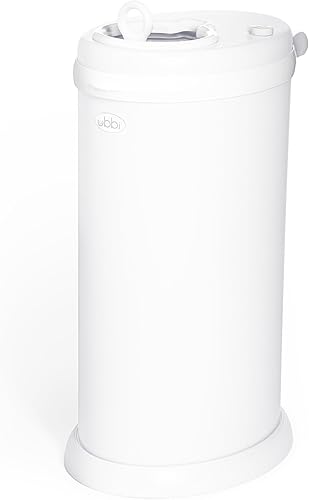
Ubbi
Ubbi Steel Diaper Pail, Odor Locking, No Special Bag Required,
$66.499,000+ bought last month
View on Amazon
A regular trash can holds diapers fine, but it lets odor build up, which matters most in a small nursery or an apartment where the nursery sits near where you sleep. A dedicated diaper pail traps that odor far more effectively, usually through a sealing lid, an individual-diaper seal, or both. The payoff is a nursery that still smells fresh at the end of a long day instead of one you can identify by scent from the hallway. Pails also concentrate diaper disposal in one spot, so you are not walking a single diaper to the kitchen trash several times a night. If your nursery is roomy and well ventilated you may get by without one, but for most small rooms a pail is one of the few accessories that genuinely earns its counter space.
The biggest build decision is steel versus plastic. Steel pails, like the Ubbi (B00821FLT4) with its alloy-steel body, resist odor absorption better over time because the smooth metal surface does not soak in smells the way porous plastic eventually can. Steel pails are heavier and tend to cost more upfront, but they are durable enough to reuse across more than one child. Plastic pails, like the Munchkin (B01BDQDIGM), are lighter and easier to move between rooms, and they often cost less to buy. The trade-off is that plastic can hold onto odor as it ages. If you expect to use the pail for several years or across multiple children, steel usually justifies the higher upfront price; if you want something light and inexpensive to relocate, plastic is the practical pick.
The single biggest factor in a pail's running cost is whether it uses standard trash bags or proprietary refill cartridges. Refill-cartridge pails, including the widely owned model at B0713M8Z5L with its 43,456 reviews, wrap or seal each diaper individually, which produces very tight odor control. The catch is that the refills are an ongoing expense you cannot substitute with a cheaper generic bag in most cases. Steel pails like the Ubbi take standard kitchen trash bags, so the only running cost is the bags you already buy. Over a year of heavy diaper use, the refill cost difference can add up to a meaningful amount. Decide before you buy whether the tighter seal of a cartridge system is worth the recurring cost, because switching later means buying a whole new pail.
Pail capacity determines how often you empty it, which matters more than it sounds during the newborn months when you are disposing of eight to twelve diapers a day. A larger pail holds more before it needs emptying, but a fuller pail sitting longer also gives odor more time to build, so the sealing quality matters as much as the raw capacity. Most parents find that emptying every two to three days strikes the right balance between convenience and freshness regardless of pail size. The Ubbi at B00821FLT4 and the refill-cartridge pail at B0713M8Z5L both handle a typical day's diapers comfortably. Consider where the pail will live and how far the nearest outdoor trash is, since a pail you have to carry far will get emptied less often, which makes a tight seal more important.
You will be using a diaper pail dozens of times a week, often with a baby in your other arm, so how easily it opens one-handed is a real quality-of-life factor. Sliding-lid designs like the Ubbi's let you drop a diaper in without lifting a lid, which is easier when your hands are full, while step-pedal and push-flap designs free up both hands as well. Refill-cartridge pails often involve a twist or clamp step to seal each diaper, which controls odor tightly but takes an extra moment. The Munchkin pail at B01BDQDIGM is built around easy one-handed use. When comparing pails, picture the actual motion of disposing of a diaper while holding a baby, because the smoothest mechanism is the one you will actually keep using rather than working around.
The right pail depends on your room and your priorities. For a small nursery that shares a wall with the parents' bedroom, prioritize the tightest odor seal, which usually means a refill-cartridge pail or a well-sealed steel pail like the Ubbi. For a larger, well-ventilated room where you want the lowest long-term cost, a steel pail that takes standard trash bags is the efficient choice. If you expect to move the pail between rooms or use it on more than one floor, a lighter plastic pail like the Munchkin is easier to carry. And if you plan to reuse the pail across multiple children, the durability of steel makes the higher upfront cost easier to justify. Start from your nursery's size and your tolerance for recurring refill costs, and the right category usually becomes clear.
Steel and plastic each have a clear advantage. Steel pails, like the Ubbi at B00821FLT4, resist odor absorption better over time because the smooth metal surface does not soak in smells the way porous plastic eventually can, and they are durable enough to reuse across multiple children. Plastic pails, like the Munchkin at B01BDQDIGM, are lighter, easier to move between rooms, and usually cheaper to buy. If you want the best long-term odor control and plan to use the pail for years, steel is generally worth the higher upfront cost. If you want something light and inexpensive, plastic is the practical choice.
It depends on the pail. Refill-cartridge pails, such as the model at B0713M8Z5L, are designed around proprietary refills that seal each diaper individually for very tight odor control, and most do not work well with generic bags. Steel pails like the Ubbi at B00821FLT4 take standard kitchen trash bags, so the only running cost is the bags you already buy. This is the single biggest factor in a pail's long-term cost, so decide before buying whether the tighter seal of a cartridge system is worth the recurring refill expense, since switching later means buying a whole new pail.
Most parents empty the pail every two to three days, which balances convenience against odor build-up regardless of the pail's size. During the newborn months you may be adding eight to twelve diapers a day, so a larger-capacity pail buys you a bit more time between emptyings. That said, a fuller pail sitting longer gives odor more time to develop, so the quality of the seal matters as much as raw capacity. If your pail lives far from the nearest outdoor trash, a tighter-sealing model helps, since a pail that is inconvenient to empty tends to get emptied less often.
Refill-cartridge pails generally produce the tightest odor control because they seal each diaper individually, which is why the model at B0713M8Z5L has accumulated more than 43,000 reviews. Well-sealed steel pails like the Ubbi at B00821FLT4 also control odor strongly and resist absorbing smells over time, with the advantage of using standard trash bags. The best choice for odor depends on your nursery: for a small room near where you sleep, the individual-seal approach of a cartridge pail is hard to beat, while a steel pail offers strong odor control with a much lower running cost.
More than most parents expect. You will use the pail dozens of times a week, often with a baby in your other arm, so a mechanism you can operate one-handed is a genuine quality-of-life factor. Sliding-lid designs like the Ubbi's let you drop a diaper in without lifting a lid, and step-pedal or push-flap designs free up both hands as well. Refill-cartridge pails often add a twist or clamp step that seals tightly but takes an extra moment. When comparing pails, picture the actual motion of disposing of a diaper while holding your baby, because the smoothest mechanism is the one you will keep using.

